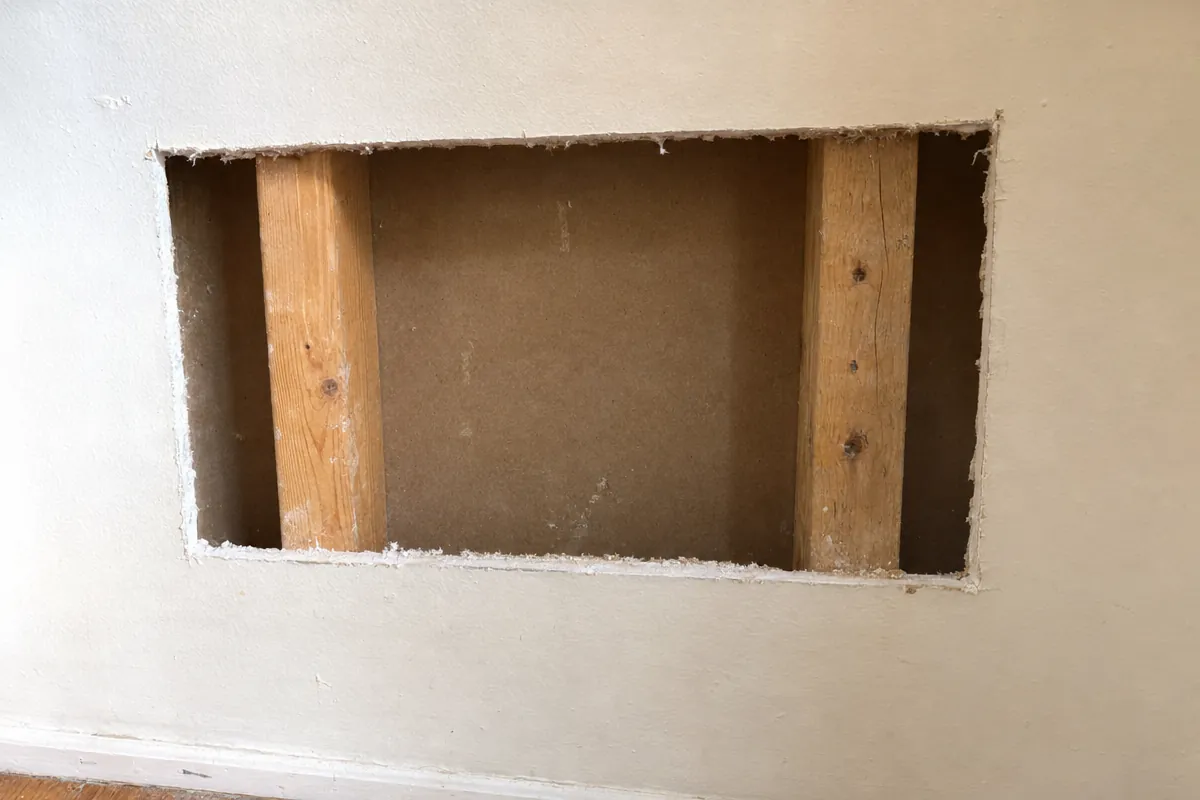
What do the openings usually look like?
Each trade leaves a recognizable mark, and the repair starts by reading it.
- Rewiring: small notches at the top and bottom of a wall, holes at outlet height, and old fixture boxes removed from ceilings.
- Shower and tub valves: a square or rectangular opening in the wall behind the fixture, sometimes in a closet.
- Pipe repairs: a cut-out in the ceiling under a bathroom or kitchen, or in a basement ceiling.
- Abandoned boxes and vents: openings left where an old outlet, phone jack or register was taken out.
Housing age explains why openings like these are so common here. The Census lists 3,840 of Butler's 7,308 homes as predating 1940, and houses that old have usually been rewired and replumbed at least once, with more updates to come.
How does a plaster wall get patched with drywall?
The ragged outline is squared off with a saw so a replacement piece drops in neatly, and wood cleats or backing go in where there's no stud. Plaster on lath is thicker than standard half-inch drywall, so the new board is shimmed or doubled until the new surface lines up with the old plaster. The seams are taped, coated and feathered wide, and the patch is primed so the wall takes paint evenly. In a drywall house the same steps apply with less shimming.
Should some openings become access panels instead?
If the opening sits behind a shower valve or over a shutoff that will need attention again, an access panel can make more sense than a closed patch. A flush, paintable panel lets the next plumber in without cutting the wall a second time. Bring it up on the phone, and the pro can price both.
When should the patching happen?
If the electrical or plumbing work needed a permit, leave the openings until the inspector has signed off, because closed walls can't be inspected. Once that's done, gather every opening in the house into one quote by listing them room by room: one patch at a time costs more in setup than the patches themselves.
For landlords, rentals are common in the city, with 3,294 of 6,116 occupied homes renter-occupied in recent Census estimates, and an upgrade between tenants is often the easiest time to get the openings closed and painted.
How much do access-hole patches run?
Fixr, which tracks U.S. averages, lists hole repair at about $60 to $200 and a typical drywall job overall at roughly $200 to $550. Read those as yardsticks from across the country. How many openings there are, how large they are, plaster thickness and whether the room needs repainting are what change a Butler quote.
Which repairs often go with trade openings?
- Drywall Hole and Corner RepairA rewire or a move often leaves dents and holes elsewhere in the same rooms.
- Plaster and Drywall Crack RepairOld plaster near a new opening sometimes cracks from the vibration of cutting it.
- Basement Water Damage RepairPlumbing work in a finished basement may follow a leak that soaked the wall.
List every opening and send them in one request; patching is arranged across Butler and the communities ringing it.
Before the openings are closed: common questions
Should the openings be patched as soon as the electrician leaves?
Only once any required inspection is done. Closing a wall before the inspector sees the work can mean opening it again.
Will paint hide where the opening was?
Level, widely feathered and primed, a patch blends into fresh paint in most light. Sheen is the usual giveaway, so repainting the full wall rather than dabbing the patch evens it out.
Can several small openings be priced together?
Yes, and it usually helps. Listing every opening in the house lets the work be planned as one job.